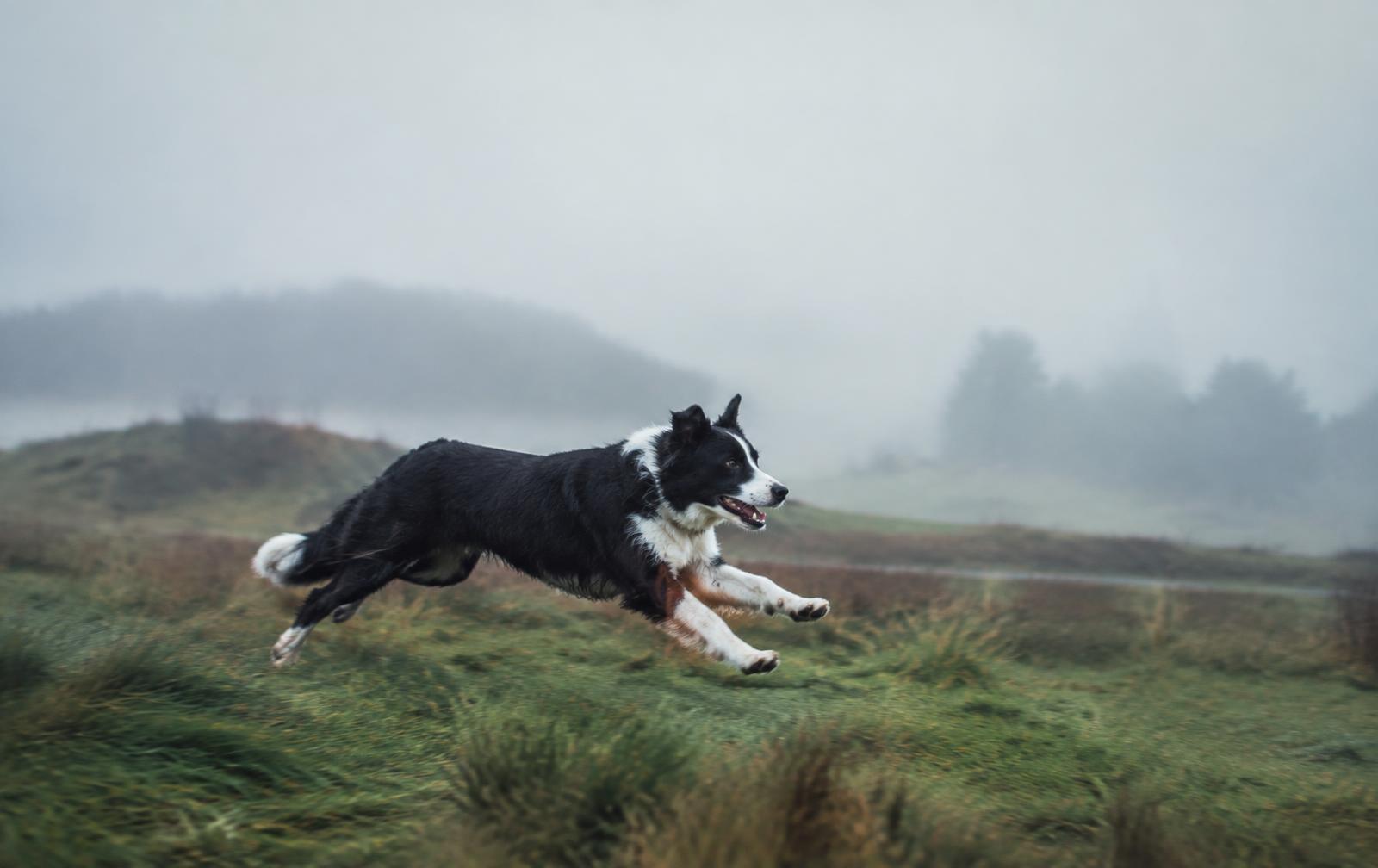
A dog sprinting after a ball, holding a point in a field or trotting beside a bike is relying on many systems at once: the nervous system that recruits muscle fibres, the heart and lungs that deliver oxygen, the chemistry that supplies energy, and the cooling and fluid balance that keep the whole body working. Fatigue and recovery are products of all of these together. No single molecule or process explains them.
This guide explains how muscle generates energy, what changes during exercise, what fatigue actually means, what recovery involves and where carnosine fits into the picture — as one part of the physiology, not the explanation for it.
How dog muscles produce movement
Skeletal muscle is made of long cells called fibres. Inside each fibre, two proteins, actin and myosin, slide past each other when the nervous system sends a signal. That signal releases calcium inside the fibre, which allows myosin to grip actin and pull. Every cycle of gripping and releasing uses energy.
Fibres differ. Some contract relatively slowly and resist fatigue; others contract quickly and powerfully but tire sooner. Dog muscle is often described as rich in fatigue-resistant fibres compared with many other species, and fibre composition varies between muscles, breeds and individuals (Acevedo & Rivero, 2006). This is one reason a greyhound and a sled dog are suited to such different work.
What is ATP and why does muscle need it?
Adenosine triphosphate (ATP) is the energy currency the contraction machinery uses directly. Muscle stores only a small amount — enough for a few seconds of hard effort — so it has to be regenerated continuously while the dog is moving. Much of the physiology of exercise is really the story of how ATP is replaced fast enough.
ATP is also needed to pump calcium back into storage after each contraction so the muscle can relax, and to keep sodium and potassium balanced across the fibre membrane. Energy supply therefore affects relaxation and nerve signalling as well as force.
The main energy systems used during exercise
Three broad pathways regenerate ATP. They overlap all the time; the balance between them shifts rather than switching on and off.
The phosphagen system
Phosphocreatine, stored in muscle, can hand its phosphate back to rebuild ATP almost instantly. It is ideal for explosive starts and short bursts, but the store is small and runs down within seconds of maximal effort.
Glycolytic energy production
Glycolysis breaks down glucose and stored glycogen without needing oxygen at that step. It produces ATP quickly, supports hard efforts lasting from several seconds to a couple of minutes, and is the pathway most associated with rising hydrogen ion levels.
In the mitochondria, oxygen is used to burn carbohydrate and fat far more completely. This yields much more ATP per unit of fuel, but more slowly. It supports almost all everyday activity and dominates longer work. Dogs have a notably high aerobic capacity for their size, which helps explain their endurance.
How much each system contributes depends on intensity, duration, conditioning and the type of activity. A fit dog can do more of the same work aerobically than an unfit one.
What happens during short, intense exercise?
In a sprint, a lure-coursing run or a burst of play, demand for ATP rises enormously in moments. Phosphocreatine falls quickly and glycolysis accelerates. Hydrogen ions accumulate faster than they can be cleared, inorganic phosphate builds up and the ionic balance inside fibres shifts. Force can fall within tens of seconds. For a fuller walk-through, see what happens inside a dog’s muscles during intense exercise.
What happens during longer exercise?
During a long hike, a day of hunting or a sled run, aerobic metabolism carries most of the load and fat becomes an important fuel. Here the limits look different: muscle glycogen can gradually run down, body heat accumulates, fluid is lost through panting, and small amounts of muscle damage add up. Fatigue in this setting builds slowly and is shaped heavily by temperature, terrain and conditioning (Hill, 1998).
What causes muscle fatigue in dogs?
Fatigue simply means a reduced ability to produce or sustain force. It is a normal, protective response, and research in muscle physiology consistently shows that it has several overlapping contributors rather than one cause (Fitts, 1994; Allen, Lamb & Westerblad, 2008). Depending on the activity, these may include:
- Energy availability — falling phosphocreatine in short efforts, or depleted glycogen in long ones.
- Metabolite accumulation — especially inorganic phosphate and hydrogen ions, which can interfere with the contraction machinery.
- Ion changes — shifts in potassium, sodium and calcium handling that affect how fibres respond to nerve signals.
- Neural factors — changes in how strongly the brain and spinal cord drive the muscles.
- Heat — rising body temperature is associated with earlier fatigue, particularly in dogs, which rely mainly on panting to cool.
- Hydration — fluid lost through panting reduces the body’s capacity to cope with heat and work.
- Muscle damage — unaccustomed or eccentric work, such as downhill running, can cause microscopic damage and lingering weakness.
- Workload and conditioning — the same task tires an unconditioned dog far sooner than a trained one.
Which factors matter most changes with the task: a ten-second sprint and a three-hour hunt tire muscles in quite different ways. Our article on muscle fatigue in dogs covers what owners can observe and when fatigue warrants a vet’s opinion.
What happens to muscle pH during intense activity?
During intense exercise, rapid energy metabolism releases hydrogen ions faster than they can be removed, so their concentration inside muscle rises and pH falls — the muscle becomes slightly more acidic. A lower pH can affect enzymes and the contraction proteins, which is one reason it is linked to fatigue during hard efforts.
The body resists sudden pH change with buffers: molecules that temporarily bind hydrogen ions. Inside muscle these include phosphate compounds, proteins and histidine-containing dipeptides such as carnosine. Hydrogen ions are also transported out of the fibre and handled by the blood and, ultimately, the lungs and kidneys. Once intense work stops, muscle pH returns towards normal.
Where does carnosine fit into muscle physiology?
Carnosine is a dipeptide formed from beta-alanine and histidine, and it is found in high concentration inside skeletal muscle. Its histidine part can accept hydrogen ions at the pH range found in working muscle, which makes intracellular buffering one of its established physiological roles (Abe, 2000; Boldyrev, Aldini & Derave, 2013).
Concentrations vary by species, muscle and fibre type, and other factors. Greyhound muscle is among the few canine tissues where histidine dipeptides have been directly measured alongside horse and human muscle (Harris et al., 1990). Even so, a plausible mechanism is not the same as a demonstrated effect: knowing that carnosine buffers does not show that more of it improves performance or recovery in dogs. For the deeper explanation, read what carnosine is and why it is found in dog muscle, or start from our pillar guide, Carnosine in Dogs: A Guide to the Science.
Why “lactic acid causes fatigue” is too simple
Popular explanations often say that “lactic acid” builds up, causes the burn and makes muscles sore. The picture is more nuanced. At the pH found in the body, what accumulates is mainly lactate, and the hydrogen ions that lower pH arise from several steps of energy metabolism, not simply from lactate itself (Robergs, Ghiasvand & Parker, 2004).
Lactate is better understood as a useful intermediate. It can be carried to other tissues, used as fuel, or converted back to glucose. Its levels rise during hard work, which makes it a convenient marker of intensity, but it is not a toxic waste product responsible on its own for fatigue. Soreness felt a day or two after unusual exercise is more closely associated with muscle damage and the repair that follows. The debate in human physiology is still active, so cautious wording is appropriate.
What recovery actually means
“Recovery” is not one process. Several things return towards normal on different timescales:
- heart rate and breathing settling towards resting levels;
- body temperature being brought back down;
- fluid lost through panting being replaced;
- energy stores — phosphocreatine and glycogen — being rebuilt;
- damaged muscle fibres being repaired and adapting;
- neural drive and coordination returning to their usual sharpness;
- the broader recovery from an unusually hard or long workload.
Some of these are fast, others slow, and the timing varies with the dog, the work and the conditions. Precise universal timelines are not well established for dogs.
Energy restoration after exercise
Phosphocreatine is rebuilt relatively quickly once intense effort stops, using aerobic metabolism. Glycogen restoration is slower and depends on how depleted the muscle became and on diet; it matters most after long or repeated hard work. Feeding a complete, appropriate diet supplies the protein, energy and nutrients muscle needs to rebuild, and working dogs may have higher energy needs (Hill, 1998).
Hydration, temperature and recovery
Dogs shed heat mainly by panting, with limited sweating through the paw pads, so hot and humid conditions make both work and recovery harder. Rest in shade, access to water and gradual cooling are core parts of recovery. Heat-related illness is an emergency: a dog that collapses, staggers or seems disoriented after exertion needs cooling and prompt veterinary care.
Working and sporting dogs
Different jobs ask different things of muscle. Sprinting and lure coursing lean heavily on rapid energy systems. Agility mixes short, explosive bursts with fast turns and jumps. Hunting and herding combine long periods of moderate work with intermittent sprints. Endurance work such as sledding or long-distance running is dominated by aerobic metabolism and fuel supply, while protection and service work can involve sudden powerful efforts after periods of waiting. Because the demands differ, there is no single recovery protocol that fits every dog (Zink & Van Dyke, 2018). More detail is in our articles on why working dogs’ physiology is different and what the science says about carnosine, exercise and recovery in active dogs.
Older dogs and muscle recovery
Ageing can reduce muscle mass and function, sometimes quietly, and older dogs may need more time between demanding sessions. Reduced activity can itself contribute to lost conditioning, which makes later activity feel harder. Muscle loss can also accompany illness (Laflamme, 2005). If weakness, stiffness or poor recovery is new or unexplained, it is worth a veterinary check rather than assuming it is “just age”. Read more about how dog muscles change with age, or see our guide to aging, activity and mobility in older dogs.
What the evidence actually tells us
Established physiology
ATP powers contraction; phosphagen, glycolytic and aerobic pathways regenerate it in overlapping ways; intense work lowers muscle pH; intracellular buffers, including carnosine, resist that change; fatigue has several contributors.
Direct canine research
Dog studies describe fibre types, high aerobic capacity, the nutritional needs of exercising dogs and histidine dipeptides in greyhound muscle. Much of it comes from specialised populations such as racing greyhounds, sled dogs and service dogs.
Other-species evidence
Most detailed work on fatigue mechanisms, lactate and carnosine supplementation comes from humans, horses and laboratory models. It helps explain general physiology but is not proof of what happens in dogs. See how to read carnosine research across dogs, horses, humans and the lab.
Practical interpretation
Sensible conditioning, appropriate rest, water, heat management and a complete diet are the well-grounded foundations of recovery. Mechanistic findings are a reason for research, not a recovery plan.
Unanswered questions
How muscle carnosine varies between breeds, ages and training levels in dogs; how quickly different aspects of recovery occur in different canine activities; and whether any change in muscle carnosine affects canine performance or recovery remain largely unstudied.
What we still don’t know
Canine exercise physiology is a smaller field than its human equivalent. Findings from elite working dogs may not describe family pets, and dog-specific recovery timelines are rarely measured directly. Where we rely on other species, we say so.