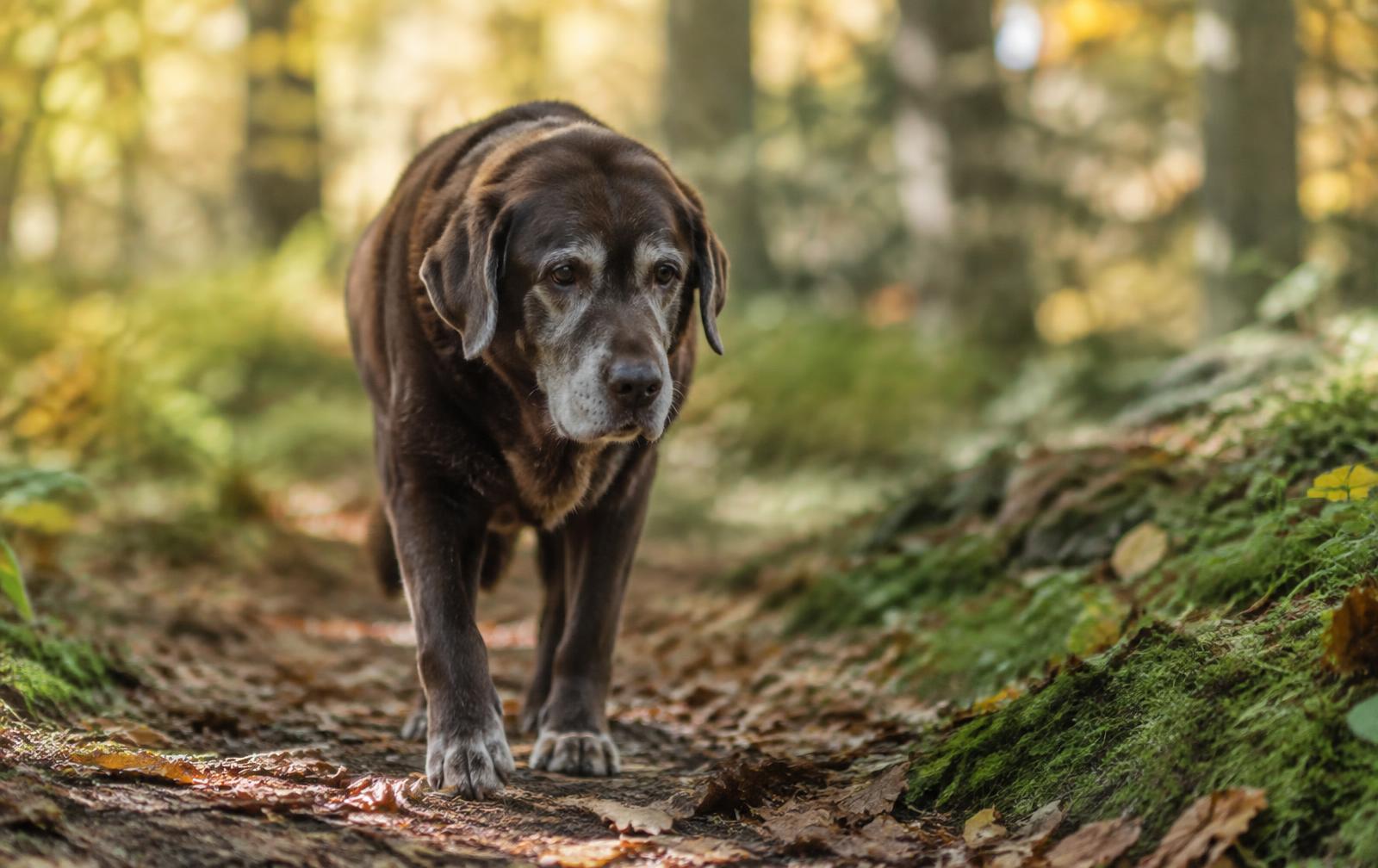
Senior Dogs
How Dog Muscles Change With Age
Many older dogs gradually lose muscle, sometimes even while their weight stays the same. Here is what is known about age-related muscle change, and how owners can help.
· 5 min read
Senior Dogs · Guide
Muscle, mobility and healthy aging in older dogs.
1 article
Aging can change a dog’s muscle mass, strength, coordination, activity level, recovery and mobility. But it does not change every dog in the same way, or at the same age. Size and breed influence when a dog is considered “senior”; health, activity history, body condition, nutrition, past injuries and chronic disease all shape how muscle holds up over time. This guide explains what is known about aging canine muscle, why some changes are not simply “old age”, and where the evidence is still thin. It focuses on older dogs specifically — for the underlying physiology of exercise and fatigue, see our guide to canine muscle, exercise and recovery.
Skeletal muscle is constantly broken down and rebuilt. With age, that balance can tip towards loss, and several changes may happen together (Laflamme, 2005; Zink & Van Dyke, 2018):
Reduced muscle mass — often most noticeable over the spine, hips, shoulder blades and skull.
Reduced function — less strength or endurance from the muscle that remains.
Lower activity — which itself reduces the stimulus muscle needs to be maintained.
Changes in neuromuscular control — how nerves and muscles coordinate movement and balance.
Changes in protein turnover — how efficiently the body uses dietary protein to rebuild muscle.
Effects of pain or disease — which can reduce movement, appetite or muscle directly.
Our article on how dog muscles change with age describes these changes and the signs owners tend to notice first.
Some gradual loss of muscle is common with age. The term sarcopenia describes age-related loss of muscle mass and function. It is widely used in human aging research and is increasingly discussed in veterinary medicine, but definitions for dogs are not yet standardised, and the word should not be read as a diagnosis an owner can make at home.
Veterinary literature also distinguishes muscle loss linked to disease, often called cachexia, which can accompany conditions such as heart disease, kidney disease and cancer (Laflamme, 2005). The two can overlap in the same dog. That is why noticeable muscle loss is worth discussing with a veterinarian rather than accepting as inevitable.
Muscle mass is how much muscle a dog has; strength and function describe what that muscle can do. They are related but not identical. A dog may look reasonably muscled yet struggle to rise because of pain, weak coordination or joint disease. Another may have visibly thinner hindquarters but still move comfortably. Owners usually see function first — hesitation before a jump, slower stairs, difficulty getting up after rest — while a hands-on examination is the better way to judge mass.
Older dogs often move less, and the reasons are rarely single. Changing energy, stiffness, joint pain, reduced vision or hearing, heat tolerance, illness and simple changes in the household routine can all play a part. Less activity is sometimes a sign that something needs attention, not just a preference for the sofa.
Deconditioning is the loss of fitness that follows reduced use. It can form a cycle:
The dog moves less.
Muscle receives less stimulus.
Conditioning and strength decline.
Activity becomes harder or less comfortable.
The dog moves even less.
This cycle helps explain why some decline in older dogs may be partly reversible with appropriate activity. But it is not the only reason dogs slow down. Pain, neurological disease, cardiovascular disease and other health problems can cause similar patterns and need veterinary assessment — encouraging more exercise is not the right answer when the underlying cause is illness or pain.
Muscle responds to use. Appropriate, regular movement may support muscle use, coordination, balance, mobility, general conditioning and quality of life (Zink & Van Dyke, 2018). Variety can help: walking on different surfaces, gentle slopes, sniffing and controlled play engage muscles differently from a single repeated route.
What “appropriate” means depends on the individual. There is no universal senior exercise programme, and this guide deliberately gives no distances, durations or repetitions. A dog with osteoarthritis, heart disease or a previous injury needs a different plan from a healthy older dog that has always been active. Veterinarians and veterinary rehabilitation professionals can help design activity — sometimes including physiotherapy or hydrotherapy — around a dog’s specific health and ability.
Some older dogs handle repeated or intense workloads differently from when they were younger. Signs such as stiffness the next day, reluctance on a second outing or slower return to normal energy can suggest a dog is finding the workload harder. Recovery depends on many things: conditioning, the size of the workload, joint and muscle health, rest and sleep, underlying disease and nutrition. There is no reliable age-based recovery timeline for dogs, so the most useful guide is how the individual dog responds. For the general physiology of fatigue, see muscle fatigue in dogs.
Nutrition supplies the materials and energy muscle needs. For older dogs, the main points are well established in veterinary nutrition guidance (Laflamme, 2005; National Research Council, 2006):
Adequate, high-quality dietary protein — veterinary reviews caution against routinely restricting protein in healthy senior dogs.
Sufficient energy, so the body does not draw on muscle protein for fuel.
A healthy body condition, avoiding both excess fat and unplanned weight loss.
Fresh water and good hydration.
A complete and balanced diet suited to the dog’s life stage.
Individual medical needs — dogs with conditions such as advanced kidney disease may need a specific diet under veterinary supervision.
No single nutrient has been shown to prevent age-related muscle loss in dogs. For more detail, read how nutrition can influence canine muscle health and our Canine Nutrition guide.
This is one of the most practical points for owners of older dogs, and one of the easiest to miss.
Body condition score primarily reflects body fat — whether a dog is underweight, ideal or overweight. It is usually assessed by feeling the ribs, waist and abdomen.
Muscle condition score reflects muscle mass. The WSAVA muscle condition score grades muscle by feeling areas such as the spine, skull, shoulder blades and pelvis, from normal muscle through mild, moderate and severe loss (WSAVA Global Nutrition Committee, 2013).
A dog can keep the same body weight while losing muscle, if fat replaces it.
Fat gain can hide muscle loss — an overweight dog can still have reduced muscle condition.
Weight and body condition alone can therefore look reassuring when muscle is declining.
Asking your veterinarian to record muscle condition alongside weight and body condition at routine visits makes gradual changes easier to track over time.
Muscle, joints and movement are closely linked. Joint pain, for example from osteoarthritis, can make a dog reluctant to move; reduced movement can lead to further muscle loss; and weaker muscle may give the joints less support. Addressing pain is often an essential part of supporting mobility, which is a veterinary matter. Practical changes at home — non-slip flooring, ramps or steps, and avoiding sudden bursts of activity on slippery surfaces — may help a dog move with more confidence.
“He’s just getting old” is an understandable explanation, but it can delay attention to treatable problems. Pain, joint disease, neurological conditions, endocrine disease, heart disease and many other illnesses can show up as weakness, reduced activity or muscle loss. Age makes these conditions more common, which is exactly why changes in older dogs deserve a closer look rather than less.
Many older dogs remain active, and some continue in sport or work. Age alone is not a reason to stop; it is a reason to watch how the dog responds and to adjust workload with veterinary input. Our guide to active and working dogs covers workload, conditioning and recovery in more depth.
Carnosine is naturally present in dog skeletal muscle (Harris et al., 1990). Human studies have investigated how muscle carnosine changes with age, and reviews discuss lower levels in some older people (Boldyrev et al., 2013). Those findings do not automatically establish the same pattern in dogs, or tell us whether any change would matter clinically. Direct canine evidence on age-related carnosine changes is limited.
There is no evidence that carnosine supplementation prevents or reverses muscle aging in dogs. For what is known about the molecule itself, see our guide to carnosine in dogs.
Claims about senior dog muscle draw on very different kinds of evidence:
Canine aging research — veterinary reviews describe age-related muscle loss and its link to nutrition and body condition, though controlled studies in dogs remain limited (Laflamme, 2005).
Established muscle physiology — principles such as muscle responding to use and disuse apply across mammals.
Veterinary nutrition guidance — requirements and assessment tools such as the NRC standards and the WSAVA muscle condition score.
Human aging research — much of what is known about sarcopenia and age-related carnosine changes comes from people, and is useful only as context.
Unanswered canine questions — how muscle carnosine changes in aging dogs, how best to define canine sarcopenia, and which interventions best preserve function.
To judge studies yourself, read how to read carnosine research across dogs, horses, humans and the lab.
Contact a veterinarian if you notice:
sudden weakness or collapse
progressive difficulty standing or rising
persistent lameness or a marked change in gait
unexplained muscle loss
reduced appetite or unexplained weight change
a major decline in activity
signs of pain
These changes should not be dismissed as “just getting old”. A veterinarian can assess the cause and advise on next steps.
Only one article is currently filed under Senior Dogs. These related articles from other topics cover background that applies to older dogs:
Can Nutrition Influence Canine Muscle Health? (Canine Nutrition)
Muscle Fatigue in Dogs: What Owners Should Understand (Muscle & Recovery)
What Happens Inside a Dog’s Muscles During Intense Exercise? (Muscle & Recovery)
How to Read Carnosine Research: Dogs, Horses, Humans and the Lab (Research & Evidence)
Many do. Gradual loss of muscle mass and strength is common in older dogs, often showing first over the spine, hips, shoulders and head. The amount varies widely: activity, health, nutrition, body condition and breed all play a part, and some older dogs keep good muscle for a long time. Loss that is rapid or marked should be checked by a veterinarian.
Muscle condition describes how much muscle a dog carries, judged by feeling areas such as the spine, skull, shoulder blades and pelvis. The WSAVA muscle condition score grades it from normal through mild, moderate and severe loss. It is assessed separately from body condition, which describes fat.
Yes. Body fat and muscle are different tissues, and fat gain can hide muscle loss. An overweight dog may keep the same weight, or even gain, while muscle declines. That is why veterinarians increasingly assess muscle condition alongside weight and body condition.
Some slowing down is common, but weakness should not be assumed to be normal. Pain, joint disease, neurological problems, heart disease and other illnesses can all cause weakness and become more common with age. New, worsening or sudden weakness deserves a veterinary assessment.
In general, yes. Regular activity suited to the individual dog helps maintain muscle use, coordination and mobility, and reduced activity can lead to further deconditioning. The right type and amount depends on the dog’s health, so there is no single senior exercise plan. A veterinarian can advise, especially if the dog has pain or a medical condition.
Muscle in older dogs still responds to use and nutrition, so some loss linked to inactivity may improve with appropriate activity and diet. How much depends on the cause: muscle loss driven by disease or untreated pain needs those problems addressed. Veterinary rehabilitation professionals can help plan safe, progressive activity.
Yes. Muscle is rebuilt from amino acids supplied by dietary protein, and veterinary nutrition reviews caution against routinely restricting protein in healthy older dogs. Sufficient energy matters too, so protein is not used as fuel. Dogs with certain conditions, such as advanced kidney disease, may need tailored diets under veterinary supervision.
Some do. Older dogs may tolerate repeated or intense workloads less well, and stiffness or tiredness the next day can be a sign. Recovery depends on conditioning, workload, joint health, rest, nutrition and any disease, so there is no fixed age-based timeline. Watching how your dog responds is the most useful guide.
Sarcopenia means age-related loss of muscle mass and function. The term comes mainly from human aging research and is increasingly used in veterinary medicine, but definitions for dogs are not yet standardised. It is different from cachexia, which is muscle loss caused by disease, although the two can overlap.
This is not known. Carnosine is naturally present in dog muscle, and some human research has reported lower muscle carnosine in older people, but direct evidence on age-related changes in dogs is limited. There is no evidence that carnosine supplements prevent muscle aging in dogs.
Any noticeable or unexplained muscle loss is worth discussing at a veterinary visit. Seek prompt advice if it is rapid, accompanied by reduced appetite, weight change, pain, lameness, weakness or collapse, or if your dog is having increasing difficulty standing or moving.
Senior Dogs
Many older dogs gradually lose muscle, sometimes even while their weight stays the same. Here is what is known about age-related muscle change, and how owners can help.
· 5 min read
Aging often brings gradual changes in a dog’s muscle, strength, mobility and recovery, but it does not affect every dog the same way, and not all decline is simply “old age”. Regular activity suited to the individual dog, adequate protein and energy, and attention to muscle condition — not just weight — are the most practical foundations. Sudden, severe or progressive changes deserve veterinary attention. Carnosine is part of normal muscle biology, but there is no evidence it prevents muscle aging in dogs.