Carnosine Basics
Do Dogs Naturally Have Carnosine in Their Muscles?
Carnosine is not something added to dogs from outside. It is made and stored in skeletal muscle — but the details for dogs specifically are thinner than many people assume.
The short answer
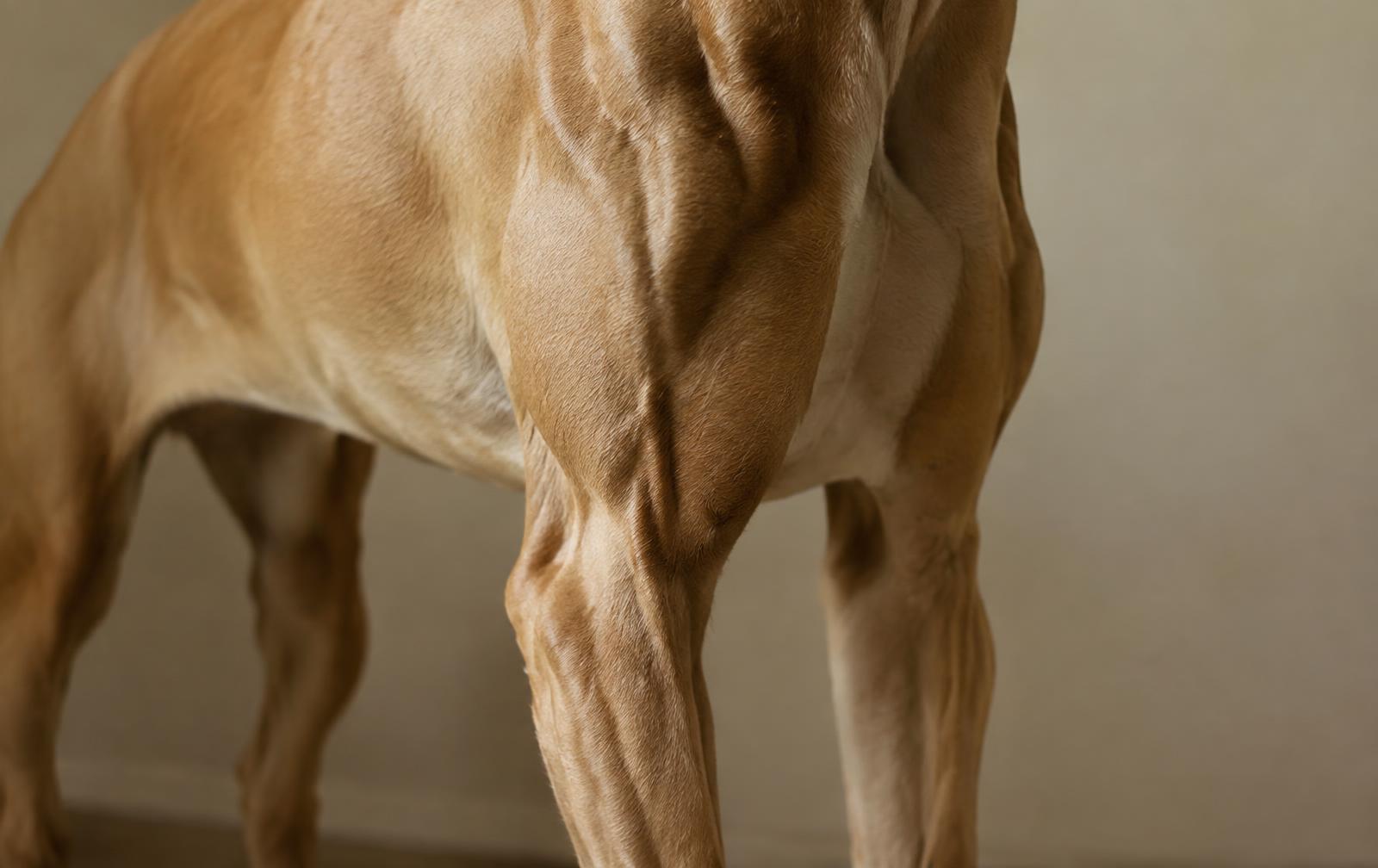
Yes. Carnosine is a dipeptide that mammals, including dogs, synthesize and store in their own skeletal muscle. Its presence in mammalian muscle is well established, and comparative studies have measured histidine dipeptides in greyhound muscle. However, direct research on carnosine levels across dog breeds, ages and activity levels is limited.
Key takeaways
- Carnosine is made inside the body from beta-alanine and histidine, mainly in skeletal muscle.
- Its presence in mammalian muscle is established physiology, not an emerging claim.
- Dogs also store a related compound, anserine; the balance between the two differs between species.
- Very few studies have measured carnosine in dogs directly, so breed, age and activity differences are largely unknown.
Questions this article answers
- Do dogs make their own carnosine?
- Where is carnosine stored in a dog's body?
- How much carnosine do dogs have compared with other species?
When people first hear about carnosine, they often imagine it as a supplement or an additive — something introduced into a dog's life from outside. In fact, carnosine is a normal part of mammalian biology. Dogs, like humans, horses and many other animals, make it themselves and store it in their muscles. The more interesting questions are how much they store, why, and how well that has actually been studied in dogs.
This article sets out what is reasonably well established, what has been measured in dogs specifically, and where the research simply has not been done yet. If you are new to the topic, our introduction What Is Carnosine and Why Is It Found in Dog Muscle? is a useful starting point.
Carnosine is made inside the body
Carnosine is a dipeptide: two amino acids, beta-alanine and L-histidine, joined together. Unlike essential vitamins, it does not need to arrive ready-made in food. An enzyme called carnosine synthase links the two building blocks inside cells, and in mammals this happens predominantly in skeletal muscle.
That means a healthy dog has its own supply of carnosine regardless of what is printed on a food label. Diet still matters indirectly, because the building blocks — particularly histidine from dietary protein — come partly from food. But the molecule itself is a product of the dog's own metabolism.
Where it is stored
Across the mammals that have been studied, skeletal muscle holds by far the largest share of the body's carnosine. Smaller amounts are found in other tissues, including parts of the nervous system. Within muscle, concentrations are generally higher in fibre types used for fast, powerful contractions, although most of the detailed fibre-type data comes from human and laboratory research rather than dogs.
What has been measured in dogs?
Here is where it is important to be precise. The general biology of carnosine is described in detail in large scientific reviews, which draw on research in humans, rodents, horses and other species. Studies that directly measure carnosine in canine muscle are much less common.
One frequently cited comparative study measured muscle buffering capacity and histidine-containing dipeptides in thoroughbred horses, greyhounds and humans. Work of this kind confirms that dogs carry these compounds in their muscle, and it places them in context alongside other athletic species. It does not, on its own, tell us how a terrier compares with a husky, or how an eight-year-old dog compares with a two-year-old.
Carnosine in dog muscle is established. The fine detail — how it varies between dogs — is mostly unmeasured.
Carnosine and its relative, anserine
Carnosine belongs to a small family of compounds called histidine dipeptides. Another member, anserine, is a slightly modified form of carnosine. Different species store different mixtures: some rely mostly on carnosine, others store substantial anserine as well. Comparative reviews indicate that dogs store both. This matters when reading research, because a study reporting "histidine dipeptides" may not be reporting carnosine alone.
Why would muscle store carnosine?
The most widely discussed role of carnosine is as an intracellular buffer. During intense muscular work, hydrogen ions accumulate and the inside of the muscle cell becomes more acidic. Carnosine's chemical structure allows it to take up some of those hydrogen ions, which helps limit the change in pH. This buffering role is well supported in mammalian physiology research. We explain the process in more depth in What Happens Inside a Dog's Muscles During Intense Exercise?.
Laboratory research has also described carnosine interacting with reactive molecules and metal ions. These findings are scientifically interesting, but much of that work is done in cells or test tubes. It should not be read as proof of a particular health effect in living dogs.
Is carnosine the same as carnitine or creatine?
No. The names sound alike, and all three are associated with muscle, but they are different molecules with different jobs. Carnitine is mainly involved in transporting fatty acids into mitochondria for energy production. Creatine supports rapid regeneration of ATP. We cover these distinctions in Carnosine vs Carnitine for Dogs and Carnosine vs Creatine.
Why carnosine levels might differ between dogs
In humans and some other species, muscle carnosine has been shown to vary with several factors. It is reasonable to expect similar sources of variation in dogs, but most have not been directly measured in canine muscle.
Muscle fibre type: fast-twitch fibres tend to hold more carnosine than slow-twitch fibres in the species studied, so muscles with different jobs may differ.
Breed and type: sprint-bred greyhounds have high muscle buffering capacity; whether other breeds differ in a consistent way is unknown.
Age: some human studies report lower muscle carnosine in older adults. Equivalent canine data are lacking.
Diet: in humans, vegetarians tend to have lower muscle carnosine than meat-eaters, which reflects beta-alanine intake. How strongly diet influences canine muscle carnosine has not been well characterised.
Training: human findings on whether training alone changes muscle carnosine are mixed.
These patterns explain why researchers find canine carnosine interesting. They do not tell us that any of these differences matter for a particular dog's health or performance.
Why canine data are so limited
Measuring carnosine in muscle usually requires a muscle biopsy: a small tissue sample analysed in a laboratory. In human sports science, volunteers can consent to this. In dogs, biopsies for research purposes raise ethical and practical questions, so studies tend to be small, to use specific populations such as racing greyhounds, or to rely on tissue collected for other reasons.
The result is a field where the basic fact — dogs store carnosine in muscle — is clear, but the detail is thin. For more on how to weigh this kind of evidence, see how to read carnosine research, or return to our guide to the science of carnosine in dogs.
What this means for owners
For dog owners, the practical message is reassuringly simple. Carnosine is not a foreign substance — it is a normal part of how canine muscle is built. A dog that is eating a complete, balanced diet and receiving appropriate veterinary care is producing its own carnosine.
What we cannot yet say with confidence is whether some dogs have meaningfully more or less than others, or whether changing a dog's diet or routine changes muscle carnosine in a way that matters for health. Those are open research questions. If you are considering any change to your dog's diet or routine, your veterinarian is the right person to discuss it with.
Practical takeaway
- Carnosine is made by your dog's own body and stored mainly in muscle.
- Its buffering role during intense exercise is grounded in established physiology.
- Dog-specific measurements exist but are few; avoid sources that present detailed canine figures as settled.
- Treat human, horse and laboratory findings as background context, not as direct evidence for dogs.
What we know
- Carnosine is synthesized in mammalian skeletal muscle by the enzyme carnosine synthase.
- Skeletal muscle holds the largest share of the body's carnosine in mammals studied so far.
- Histidine dipeptides have been measured in greyhound muscle in comparative studies.
What we don’t know yet
- How muscle carnosine varies between dog breeds, sizes and ages.
- Whether training changes muscle carnosine in dogs.
- How diet influences canine muscle carnosine over time.
Bottom line
Carnosine is a normal part of canine muscle. What remains open is how much dogs have, how that varies, and whether it changes meaningfully with training, diet or age.
References
- Boldyrev AA, Aldini G, Derave W. Physiology and pathophysiology of carnosine. Physiological Reviews 93(4):1803–1845. 2013.[General / Review, Review]Comprehensive review of carnosine biology across species. Source PubMed
- Harris RC, Marlin DJ, Dunnett M, Snow DH, Hultman E. Muscle buffering capacity and dipeptide content in the thoroughbred horse, greyhound dog and man. Comparative Biochemistry and Physiology Part A: Physiology 97(2):249–251. 1990.[Dog, Comparative measurement study (dog, horse, human)]One of the few studies to measure histidine dipeptides in canine (greyhound) muscle. Source PubMed
- Abe H. Role of histidine-related compounds as intracellular proton buffering constituents in vertebrate muscle. Biochemistry (Moscow) 65(7):757–765. 2000.[General / Review, Review]Comparative review of muscle histidine dipeptides across vertebrates. PubMed
Carnosine for Dogs Editorial Team
Editorial Team
The Carnosine for Dogs Editorial Team creates evidence-led educational content about canine carnosine, muscle physiology, activity, recovery and related research.